AdShot
Benchmarking Multimodal Large Language Models for Video Advertisement Clipping
Wen Xie1, Om Rastogi1, Sai Siddhartha Vivek Dhir Rangoju1, Gijs Overgoor2, Yakov Bart1, Sarah Ostadabbas1
1Northeastern University 2Southern Methodist University
The problem
Advertisers release the same campaign at several durations — most often 30 and 15 seconds. Producing the shorter cut means deciding, shot by shot, what survives: slow, repetitive editorial work repeated across the thousands of ads a brand makes.
Ads are an unusually hard case for video models. A 30-second spot packs 10–20 shots of only 1–3 seconds each, and every shot plays a strategic role — informing, persuading, or prompting action. Good clipping is not “keep the highlights”: it has to preserve a balanced message under a hard time budget.
The benchmark
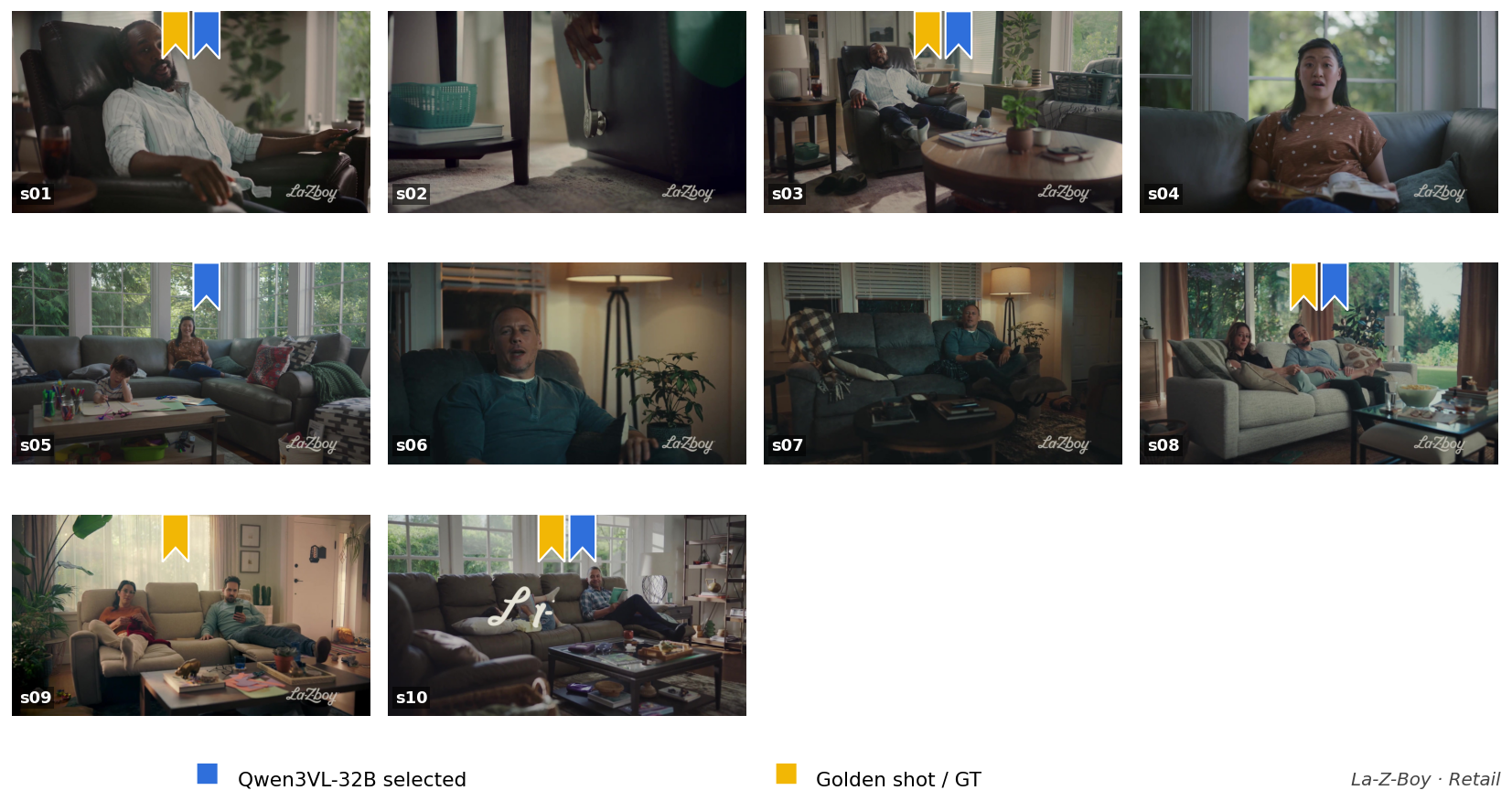
AdShot contains 823 professionally edited ad pairs — a 30-second source ad and the 15-second cutdown released by the same brand — spanning 194 brands across 17 industries.
Because both versions are publicly released finished products, pairing them recovers the editor’s real decisions at no annotation cost. The ground truth is not a proxy or a crowd label: it is the edit a brand approved, paid for, and put on air.
Pairs are built by detecting shot boundaries with AutoShot, embedding each shot with Swin3D, and matching 30s to 15s shots by clustering. Two annotators independently reviewed 50 pairs and agreed on all 401 shot judgments; automated matching agreed with human judgment 98.2% of the time. Every shot also carries 18 binary content labels grouped into action, information, emotion, and imagery.
What we found
We evaluated 15 MLLMs (13 video-only, 2 audio-visual, 7B–72B) zero-shot on shot-selection accuracy, duration adherence, and content preservation.
1. Architecture matters more than scale. A 32B model beats a 72B one, and 7–8B audio-visual models nearly match the best video-only model at a third of the parameters. Nine of the fifteen models beat a random baseline (F1 0.503) and six fall below it — including the largest model evaluated. The ability to extract editorial signal is model-dependent, not a property of MLLMs in general.
2. Duration control is the weak point. Mean absolute duration error is 5.39 seconds against a ±1 second tolerance, mostly overshoot. High F1 is usually bought by over-selecting: the top-scoring model runs about 12 seconds long.
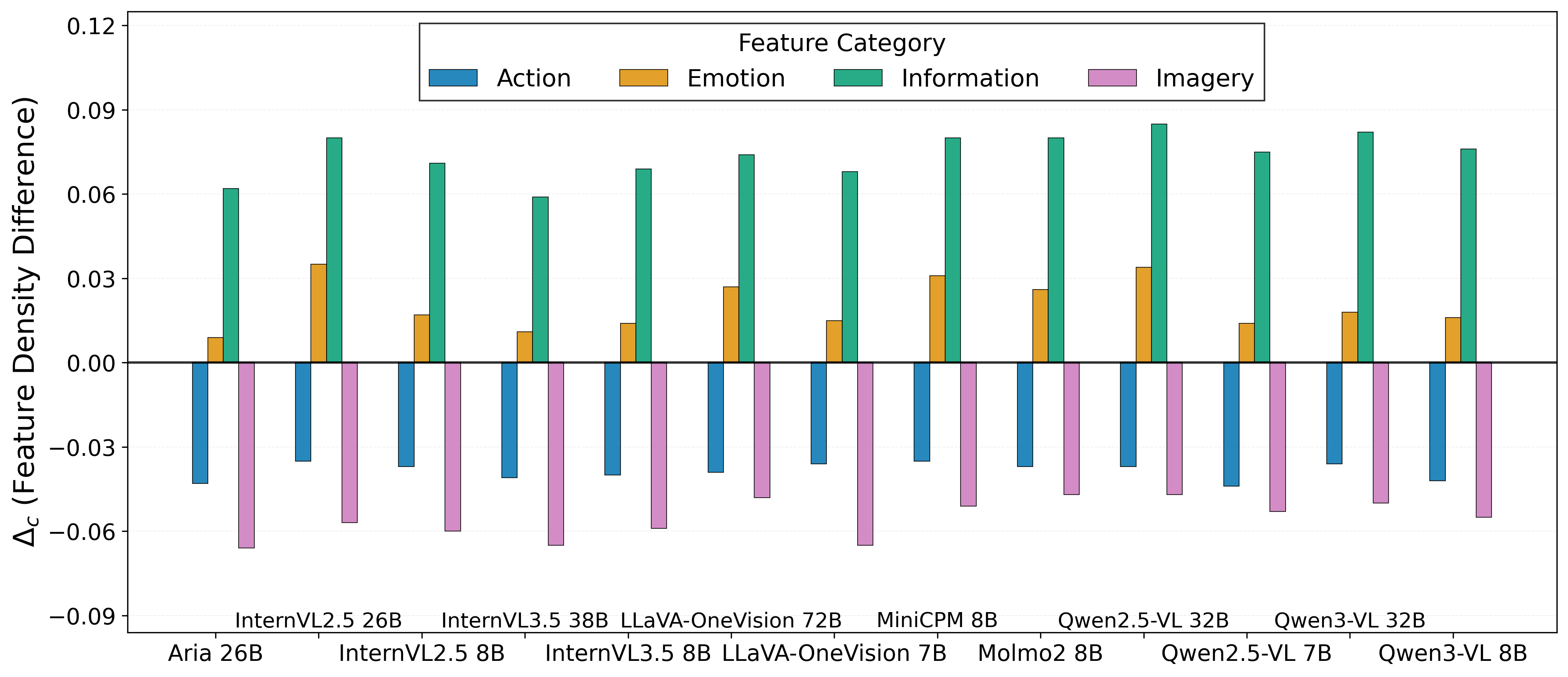
3. Every model edits with the same slant. All 15 over-select information- and emotion-focused shots and under-select action and imagery, relative to the professional edit. Scale does not fix it — a 72B model shows the same bias as an 8B one. A strong accuracy score can coexist with a systematically mis-composed ad.
Audio helps too: removing the audio channel from the same audio-visual model drops F1 by up to 0.083, driven by recall, and the gain holds in 14 of 17 industries.
What it means
MLLMs can already shorten an editor’s shortlist, but not run unsupervised — they overshoot the clock and quietly rebalance the message. They are useful as assistants with a human in the loop, and AdShot’s paired edits are built to fine-tune them into something better.
Dataset
The benchmark is available on Hugging Face under CC BY-NC 4.0. It includes shot boundaries, the ground-truth shot matching between each 30s/15s pair, 18 content-feature labels per shot, and derived per-shot keyframes and audio for the source ads. No source video is redistributed; the full ads can be retrieved from YouTube via its Data API.
Citation
@inproceedings{xie2026adshot,
  title     = {AdShot: Benchmarking Multimodal Large Language Models
               for Video Advertisement Clipping},
  author    = {Xie, Wen and Rastogi, Om and Rangoju, Sai Siddhartha Vivek Dhir
               and Overgoor, Gijs and Bart, Yakov and Ostadabbas, Sarah},
  booktitle = {Advances in Neural Information Processing Systems (NeurIPS),
               Evaluations and Datasets Track},
  year      = {2026}
}